PIGGYVEST
EXPLAINERS
turning complex ideas into content people actually want to read
01 — the opportunity
Piggyvest already had two strong editorial territories: personality-led stories such as those on Women & Money and On the Money, and SEO-driven content designed to answer specific questions and explain technical terms. I saw an opportunity between the two.
There was room for content that could take a genuinely difficult, obscure, or timely subject and make it clear enough to understand, interesting enough to finish, and culturally relevant enough to remember.
That was my thinking behind the explainer format I developed for the Piggyvest blog. Rather than treating explainers as purely educational or search-driven content, I approached them as a way to give consumers something valuable for free, increasing the company's legitimacy and goodwill, feeding the engagement funnel and pulling users further into the business's ecosystem.
02 — the strategy
I developed two editorial territories within the explainer vertical.
Current affairs
These explainers respond to things people are already talking about, but may not fully understand. For example, when Nigeria's official inflation rate fell while everyday expenses remained stubbornly high, I wrote:
If Inflation Rate Is Down, Why Is Everything Still So Expensive?
The idea was to bridge the gap between economics and the lived experience of a person going to the market to provide useful context as to what was going on.
Also, when the Dangote Refinery IPO became a major talking point, I wrote:
Dangote Refinery IPO: An Introduction
The goal wasn't simply to explain the IPO. It was to give readers enough context to understand why the story mattered in the first place.
Midnight curiosities
The second territory is less economically obvious, but just as important. These pieces answer questions that make people stop and think: "Wait… that's actually true!" For example: Why Are There No More ₦5 Notes in Circulation?
A story like this isn't necessarily designed to generate an immediate economic response. Instead, it gives Piggyvest an opportunity to be useful, interesting and distinctly human, which is directly tied to the brand's goals. It creates a small moment of delight in the consumer that endears them even more to the brand.
03 — building an explainer
I use five principles.
- 01 — Start with a human hook. A technical subject should begin with a human problem the reader already understands. For the inflation piece, that meant starting with the experience of going to the market and wondering why everything still feels expensive.
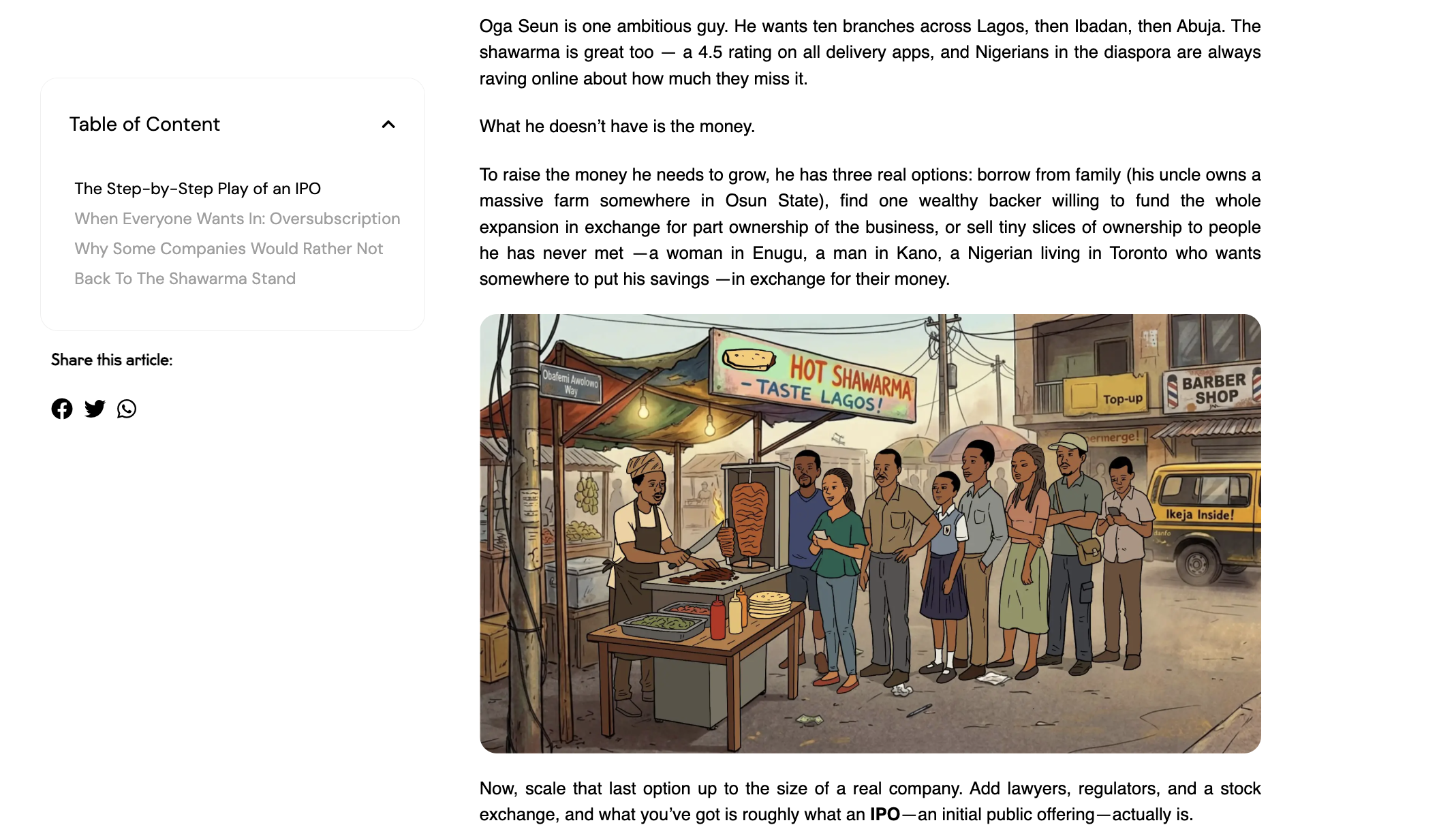
- 02 — Give people something to hold onto. When a concept is abstract, I look for a concrete illustration to make it stick. In the lifecycle of a stock, for example, I use the story of Grace buying shares to give readers a mental model they can carry.
- 03 — Put the information in its cultural context. These pieces are written specifically for Nigerians, so the examples, references, humour and framing reflect that reality.
- 04 — Do proper research. The writing may feel conversational, but the thinking isn't. I seek insight from authoritative sources online and within the Piggyvest team to ensure there are no gaps.
- 05 — Introduce the brand naturally. Not every piece of branded content should end with a hard sell. The reader should first get what they came for: an answer, insight, or genuinely enjoyable read. Only then should the brand enter the conversation. Value → trust → alignment → consideration.
04 — the goal
I never expect someone to read an explainer and immediately open a Piggyvest account. I want a reader to leave thinking at least one of the following: That finally makes sense. I learned something today. That was actually fun to read.
This matters because brands don't only build relationships at the point of conversion. They build them through repeated experiences of being useful or interesting. My goal was for Piggyvest to become associated not only with what it sells, but with the feeling of providing knowledge to the world, for free, by making difficult topics easier to understand.
05 — audience response
The strongest evidence I currently have is qualitative feedback from readers. Here are a few:
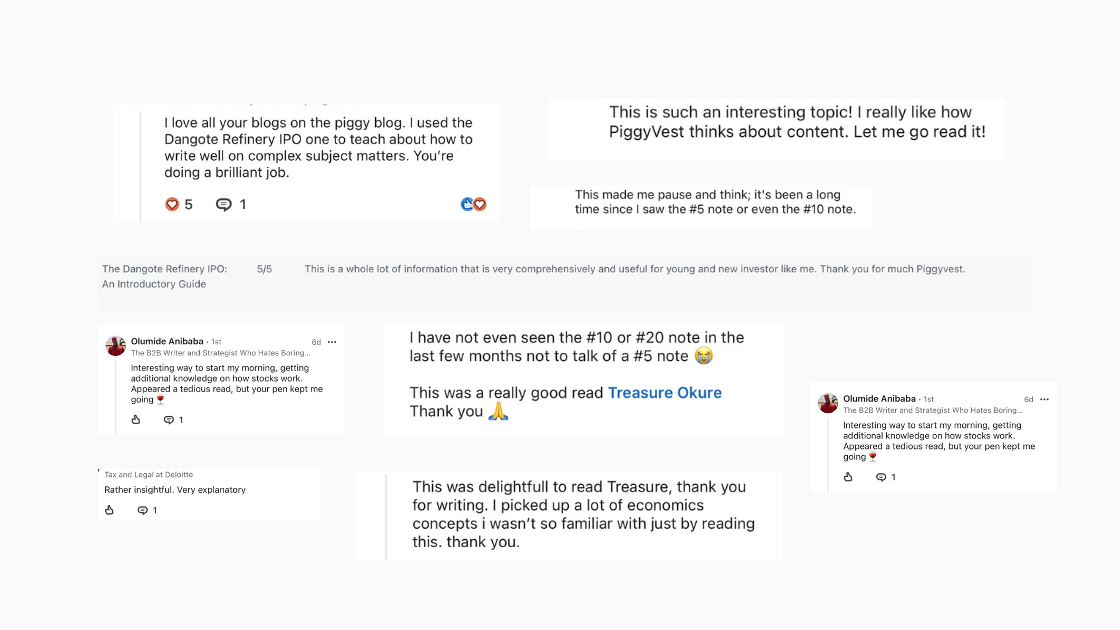
These responses capture the intended outcome: clarity without dryness, easily digestible education, and content that doesn't feel like an advertisement.
06 — takeaways
Good branded content doesn't always need to ask the audience to do something. Sometimes its job is to make someone stop, understand something they previously found confusing, learn something they didn't know, or have a conversation they wouldn't otherwise have had.
This kind of value compounds. In an environment full of listicles and content created to fill a search query, there is an opportunity for brands to find an interesting question, do the work to understand it, and explain it beautifully. That's the kind of content I enjoy making.